August 4, 2022
What are REITs
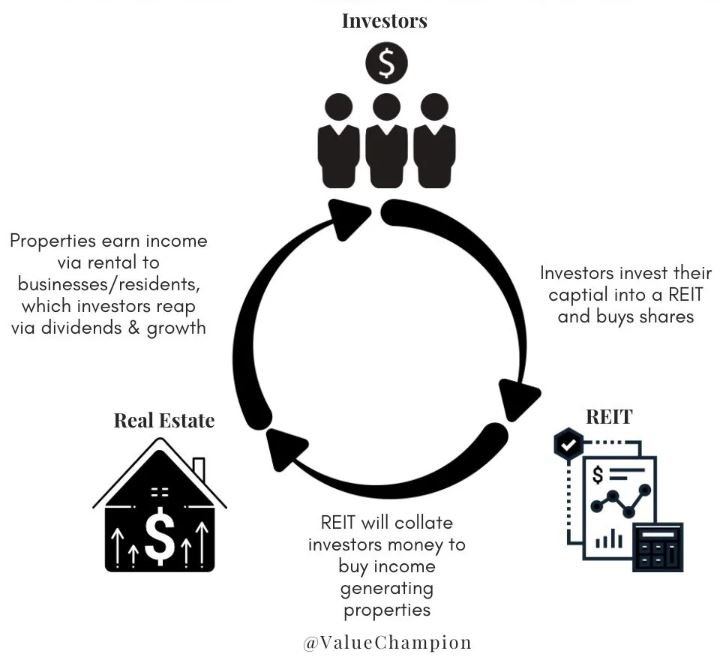
1. Nature of REITs/Industry
As mentioned, REITs can come in the form of specific sectors, such as retail, industrial, hospitality or commercial. Certain sectors like the healthcare and infrastructure REITs will be more resilient whereas the hospitality and industrial REITs may prove to be good for a rebound. Hence, you may want to identify the nature of the REIT first in order to understand what to expect a few years down the road.2. REIT's Profitability
What interests you next will be the dividends it can offer. As it is mandated for a REIT to distribute at least 90% of income as dividends, the higher the profitability, the higher returns you can get. To determine the REIT's profitability, a simple guide will be to look out for its property yield and occupancy rate. (i) The property yield gives you a percentage of how much the company is earning, as compared to the value of its property. It is calculated by dividing the total loan of a REIT by its total assets' size.Property Yield = Net Property Income (NPI) / Total value of properties (based on the latest available valuation) * 100%
The higher the rental yield, the higher the income for the company. However, do take note that if the rental yield is too high, it may pose an issue in retaining its tenants. (ii) On the other hand, the occupancy rate gives you a good indication of the percentage of property being rented out. More importantly, we want to see a constant or increasing %. A decline in the occupancy rate may sound an alarm that the REIT is not able to attract tenants and it will affect it over the long run.3. REIT's Gearing Ratio

The gearing ratio is calculated by dividing the total loan of a REIT by its total assets.
Gearing Ratio = (Total borrowings / Total Assets) * 100%
Under the MAS regulations, REITs in Singapore require the gearing ratio to be below 45%. But the covid-19 situation has let MAS change the leverage limit to 50%.
This is to provide S-REITs greater flexibility to manage their capital structure amid the challenging environment created by the COVID-19 pandemic.
That said, a relatively low gearing ensures that when asset prices come down, there’s still enough margin of safety before the gearing limit is breached. Another area you may want to look at is the interest coverage ratio. This ratio allows you to determine if the company is able to pay off the interest expenses on its outstanding debt. It is calculated by dividing a company’s earnings before interest and taxes (EBIT) by the company’s interest expense for the same period.4. REIT Management Fees
Different REITs will incur different fees and charges. An example will be the asset management fees payable to the REITs managers. Other charges may include repair or maintenance costs for the buildings. These fees may take a bite out of your returns so it is wise to take a look at them before making a decision. The gist is that the REIT manager should be taking credit when they perform well - aligning their interests with the unitholders.5. Dividend and Management/Sponsor Track Record
Other factors you may want to consider include:- Past track record of dividends - Do the REIT consistently deliver its dividends for the previous few years?
- Is the management team capable of developing AEI (asset enhancement initiatives) OR sourcing for new, income-accretive assets?
- How about the sponsor? Is it one with a strong financial backing and big pipeline of buildings which can be injected into the REIT for steady growth in future?