Your 5 Minute Guide to Powerwell Holdings Bhd

Looking for a trusted Stock Remisier?
Augustine works closely with a small group of clients - providing regular market updates, Bazi & astrology wealth insights, and clear guidance to invest with confidence.

📩 Check out my profile here today!

On 2 January 2020, Powerwell Holdings Bhd (Powerwell) has extended to all an invitation to subscribe its IPO shares at RM 0.25 a share. The application for IPO shares of Powerwell would be closed on 10 January 2020. You can download its IPO Prospectus below:

Powerwell’s IPO

Part 1
Powerwell’s IPO

Part 2

  You can go through some 350+ pages of the IPO document or alternatively, you can spend 5-10 minutes reading this write-up, where I’d listed down 7 things to know about Powerwell : 

1. Business Model 

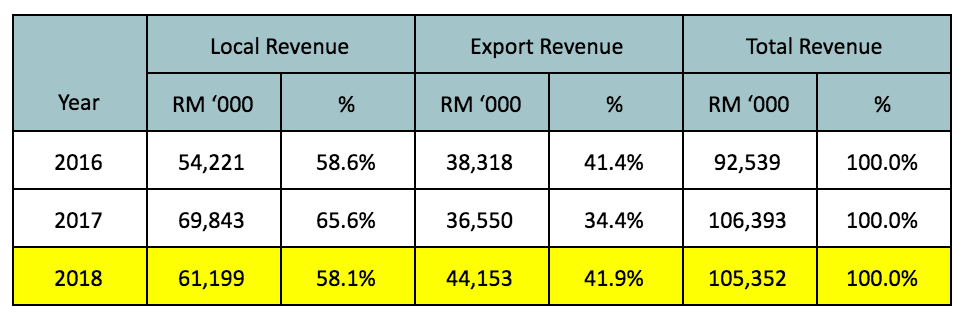
Powerwell derives income from design, manufacturing, and trading of electrical distribution products, which consists of LV switchboards and MV switchgears. It operates four plants, where two are based in Kota Kemuning, Selangor and two are located in Binh Duong, Vietnam.  Its products are sold to main contractors, mechanical and electrical contractors, and EPCC contractors locally and via appointed distributors if they are exported to overseas market. From 2016 to 2018, Powerwell has made around 40% of its sales from overseas market mainly Vietnam, Bangladesh, and Indonesia.  

2. Financial Results 

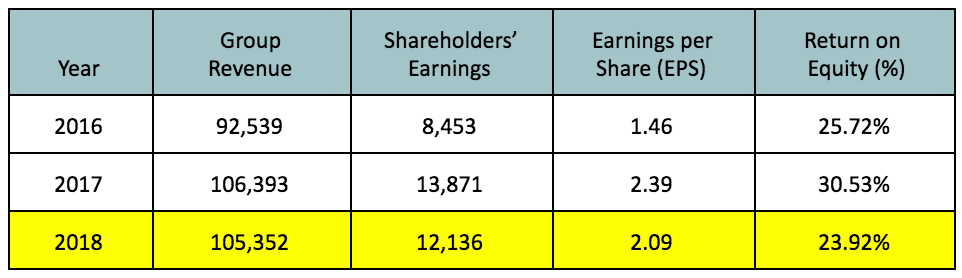
For the past 3 years, Powerwell has achieved marginal growth in revenues from RM 92.5 million in 2016 to RM 105.4 million in 2018. In 2017, its revenues were boosted by higher projects secured in Vietnam. Meanwhile, its revenue in 2018 was boosted by higher projects secured in Bangladesh, which offsetted its drop in projects secured in Vietnam.  With slightly better margins, Powerwell recorded higher shareholders’ earnings from RM 8.45 million in 2016 to RM 12.14 million in 2018. The 3-year return on equity (ROE) average is 26.72% per year. This means, Powerwell had generated, on average, RM 26.72 in annual earnings from every RM 100.00 it has in equity for the last 3 years.   

3. Balance Sheet Strength

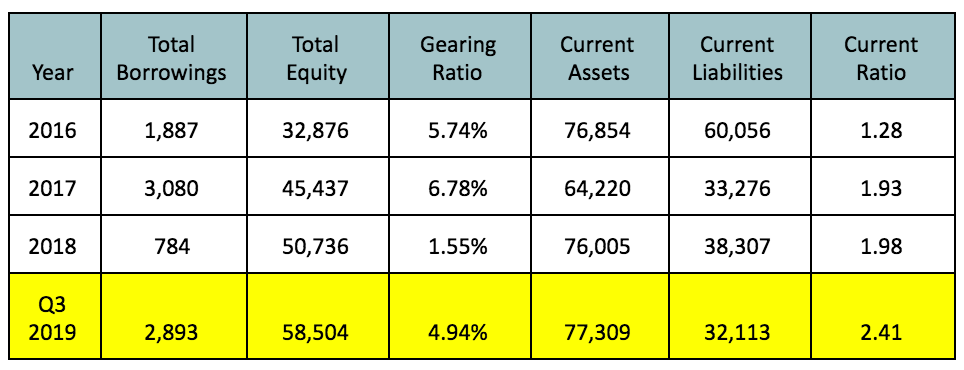
As of 30 September 2019, Powerwell has RM 2.89 million in total borrowings. It has RM 58.50 million in total equity. Thus, its gearing ratio is 4.94%. In addition, Powerwell has reported to have RM 77.31 million in current assets and RM 32.11 in current liabilities. Thus, its current ratio is 2.41.  

4. IPO Proceeds 

Powerwell intends to raise RM 21.85 million in gross proceeds, where it intends to utilise it for the following purposes:  a. Capital Expenditures (RM 10.27 million)  This includes purchases of machinery & equipment such as 1 CNC turret punch machine, 1 busbar machine, 2 automated bending system, 1 bending machine, 1 hydraulic ironworker, 3 MV test machines and upgrading of its ERP systems.  b. Certification Expenditures (RM 3.87 million)  Powerwell intends to obtain IEC standards-compliant certifications for its range of products to enhance their status and marketability to customers who require switchboard products that possess IEC certification.    c. Working Capital (RM 3.62 million)  This includes RM 2.3 million in purchases of materials and components and RM 1.3 million in marketing expenses, where it intends to increase its participation in various international electricity industry trade fairs and exhibitions.  d. Estimated Listing Expenses (RM 4.10 million)   

5. Major Shareholders 

PW Synergy will emerge as the biggest shareholder of Powerwell Holdings Bhd with 51% shareholdings of the company. Thus, Jason Tham and his sister-in-law, Catherine Wong are key shareholders of Powerwell Holdings bhd through their 7.18% and 7.02% direct shareholdings in the company and their indirect stakes in PW Synergy. Jason Tham is the Managing Director of the company. Catherine Wong is appointed as an Executive Director of the company.   

6. Risks 

Powerwell is subjected to the following risks:  a. Fluctuations in Revenue, Profits and Cash Flows from Operations  This is because Powerwell’s source of revenues are largely project-driven and it does not have any long-term contracts with any particular customer. The future profitability of Powerwell lies in the management’s ability to continue to secure new projects from both existing and new customers in years to come.    b. Reliant on the Construction Industry  Its customers are mainly contractors, mechanical and electrical contractors and EPCC contractors in the building and construction industry. Hence, demand for switchboard products is highly influenced by the condition of the construction industry.    c. Volatility in Raw Material Prices The key materials used to manufacture metal sheets and copper busbars. Thus, it is subjected to price volatility resulting from volatility in global metal prices.   

7. Valuation 

At RM 0.25 a share, its IPO shares are offered at P/E Ratio of 11.96 based on its earnings per share (EPS) of 2.09 sen and P/B Ratio of 2.08 based on its latest net asset value (NAV) of RM 0.12 as of 30 September 2019. It does not set itself a fixed dividend policy at the moment.   

Conclusion: 

Powerwell has delivered a string of profits for the last 3 years. These profits had been made through past projects which have been completed. They would not contribute to future revenues and profits. Presently, Powerwell has an unbilled order book of RM 52.21 million, which would be billed progressively until 2020. Beyond that, its performance would be dependent on its ability to secure new contracts with existing and new customers in future years to come.  
FREE Download - "7 Top Stocks Flashing On Our Watchlist" Psst... We’ve found 7 exciting companies that are poised to skyrocket >100% in the years to come. Simply click here to uncover these ideas in our FREE Special Report!

About the author Ian Tai

Check Out Our Latest Articles

DBS Group – A Bazi Analysis

Many investors would have known about DBS Group Investors would have make decent gains as the share price has been rising for the past few years. In fact, investors would have gain a total return of 131.93% excluding dividends received if he purchased the share 5 years ago! Many investors would already know about the

Read More

Apple Stock Analysis: Using Fundamentals and Bazi

This is an in depth analysis on Apple stock both using Fundamental and Bazi analysis. Apple remains a cash-generative, platform-centric technology leader with a resilient earnings mix. In fiscal Q4 2025 Apple posted revenue of $102.5 billion and non-GAAP EPS of $1.85, driven by a strong iPhone cycle and record Services revenue. That result reinforced

Read More

3 SGX High Yield Small Cap Dividend Stocks to Watch

Looking for SGX high yield small cap dividend stocks that offer strong passive income potential without relying only on large-cap blue chips or REITs? In Singapore, most dividend investors immediately turn to banks, REITs or government-linked companies for stability, but there are smaller gems that may offer attractive yields while still operating solid business models.

Read More